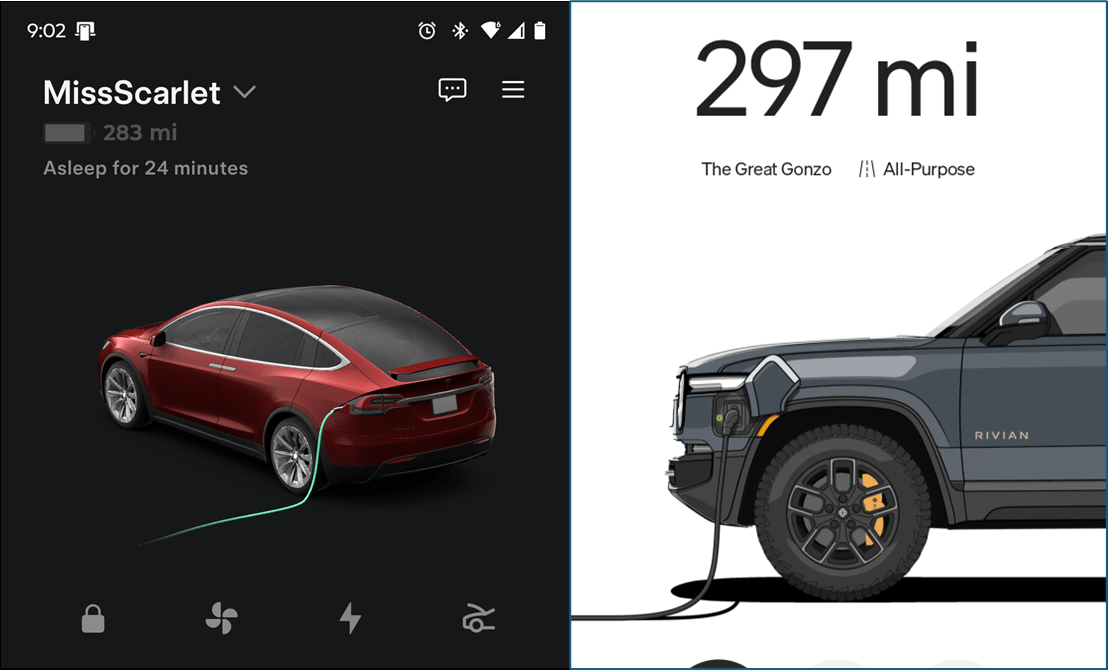
Rivian v Tesla (I’m a Mac, and I’m a PC)

Update 8/12: We just got the car back from the Bellevue Rivian service center and it does appear that the car had a problem with the cooling system (the infamous 5-way valve others have posted about, e.g., here). Service took way too long — they’re clearly struggling with the logistics of scale-up — but they got me a reasonable loaner and (I think) found the root cause. Hopefully we’ll have a smoother fast charging experience when we head back to California in a couple of months. Woo hoo!

As I mentioned a couple of weeks ago, we recently traded in our trusty 2019 Tesla Model X (“Miss Scarlet”) for a 2025 Rivian R1S (“Gonzo the Great”). We bought the Tesla for a combination of selfish and political reasons, and traded it in for those same reasons. But I have strong feelings about the legacy auto industry and EVs — first because of the decades they spent trying to slow-boat the transition, and second because their EVs just kind of suck. I want a software car, not a legacy gas car with the engine swapped out.  

To me at least, Rivian stands out as the next generation of true EV first technology. Their experience with delivery trucks has given them a ton of experience in a tough environment, and Keep the world adventurous forever speaks not just to a sustainable future, but an awesome one.

So — into the breech we went. Our primary use cases for the car are pretty straightforward and unique to our weird lives:

  1. Short trips around town
  2. Ferry rides to and from Whidbey
  3. Multi-day road trips up and down the West Coast
  4. Drive in movies

I waited to write this until we had our first experience with #3. And while we did run into one significant unpleasantness (see “The Ugly” below), on balance I’m pretty enthused about the vehicle. Fingers crossed…

Purchase and Delivery

Industry inertia (and lobbies) are amazing things. Thanks to a bunch of archaic regulations wrt dealer networks, you can’t actually buy a Rivian (or a Tesla) in Washington State. When we went to test drive the car at University Village, the reps were very clear: we can’t talk about selling you this car, the price, your trade in, or anything like that. We’re just letting you take a ride in this wonderful vehicle and answering questions about it!

When it came time to actually buy the car, we had do so online, nominally from Illinois. They’ve done a good job with the process of providing them with documentation, signing notary forms, wiring money, etc. — actually way better than the typical dealer circus.

The car showed up at the Bellevue service center, and a super-enthusiastic lady spent an hour with us walking through all of the features. She was a bit over the top — but I appreciated what seemed to be honest enthusiasm for the car and the company. A good start! We waved goodbye to Miss Scarlet and drove off home.

Fun related fact — when the registration showed up in the mail, it showed a (large) itemization for use tax, the kind you pay to the state when buying a used vehicle from a private seller. This was in lieu of WA sales tax, and our last reminder of the dealership lobby — we actually bought the car “used” and imported it from Illinois!

The Good (a lot)

Our Rivian is an R1S “Tri-Motor” (SUV style). Fully-charged range is just under 350 miles, and those extra miles (compared to the X) really shine. It is super-fast and accelerates like a beast. Definitely BIG and TALL, even in “kneeling” mode — we added EV Sportline running boards to help folks get in and out more easily (a nice product BTW — we also bought their new Aero Cover Plates but I’d skip those next time).  

The suspension is crazy nice … the Tesla raises and lowers itself as well, but with a spread of 6.5 inches (from 8 to 14.5) the Rivian’s ability to adjust is insane. The road to our Bellevue house has these killer abrupt speed bumps — in the Tesla it was bone shaking; in the Rivian I barely notice them at speed (sorry neighbors).

Everything about the cabin is nicer as well. The boxy shape of the Rivian makes it way easier to transport stuff, the seats are cushy on my back even over a 12-hour day, and the console is well-designed so I can see everything (on the Tesla I kept having to peer around the wheel to see important stuff on the heads-up).

A frunk you can hose out is a great touch for those of us who use it to move trash.

I am in love with the wifi hotspot. Being able to cast any video to the car is super, although I have had an issue or two getting the phone to “see” the Rivian.

Dog mode (I mean “creature comfort”) is basically equivalent to the Tesla, but Camp mode is better in the Rivian. There’s a lot more control of what is on and off, and the automatic leveling feature is pretty nifty. Love the ability to illuminate around the vehicle easily, especially picking up mail or dropping trash late at night.

The adaptive/matrix headlights are simply magic. I posted a picture of their “charging” display last time, but the really cool bit is how they work when driving. Instead of just two headlights, there’s a whole bar of individually-focused LEDs which stay in high beam mode permanently. When they detect an oncoming vehicle or person they turn off only the lights directed at that object. The difference in visibility is striking.

Some of these are just better because the car is five years newer than our Tesla (Canada started allowing adaptive lights in 2018). But that doesn’t make me any less giddy; e.g., I cannot express how much I love the synthesized overhead view for parking. Did I mention it’s a big car? Having perfect view of lines and curbs is life changing.

The Less Good (Driver Assist)

Rivian has some great automated driving features, but it doesn’t touch the Tesla. I loved Full Self-Driving on our X. It isn’t perfect by any means, but the idea that the car really knows how to drive itself anywhere and in virtually any environment is a big, hairy, wonderful goal. And Tesla is getting there.

The Rivian is much more about helping you drive conveniently and safely — and it honestly does a very good job of that. It’s just not the same thing, at least not yet. It currently has three assist modes:

  1. Adaptive cruise control.
  2. Driver Assist. This is available on most highways and will keep you in your lane. It will perform safe lane changes on request only (using the turn signal).
  3. Enhanced Driver Assist. The same as #2 but hands-free. Available about 2/3 of the time that regular Assist is enabled.

Adaptive cruise works great, easy peasy. The quality of driving in the Assist modes is solid but it does get fooled sometimes; our working theory is that it struggles with spotty road coloring and lane markings. A few times we got into a weird harmonic where it kept swerving back and forth within the lane, and twice on our big drive it lost track without knowing it.

The other challenge is that the Assist features are clearly map-driven. Of course the car is adapting to its immediate situation, but the features are enabled/disabled based on map location and how much the system knows about the road layout. Because roads are always changing, this means that the feature frequently turns itself off and on. This is especially true with Enhanced mode — there are significant parts of I5 where it’s just not worth using it, because it’ll just be off again in thirty seconds.

The eye tracking is also really aggressive — I can barely pick a song on the main console without it yelling at me to look at the road.

All in all — by the middle of day one I’d figured out the idiosyncrasies and we were humming along pretty well. The overall experience is a lot like the Tesla before FSD. But I expect it will take a big stair step before they’ll go much beyond that — we’ll see.

The Ugly (Battery Temperature)

OK, this one was a killer. I’m optimistic that it’s not a fatal flaw in the car — when we’re back in Bellevue I’m going to have them see if we may be a victim of a bad cooling valve; hopefully that’s all it is. Still, it sucked.

We were impressed with our first stop at an EVgo station in Aurora, OR. The charge was amazingly fast compared to what we were used to with the X. In and out, off we go.

The second stop was a Rivian Adventure Network station in Roseburg, OR. It was pretty warm out at this point, about 92. Started fine (and fast), but after taking the dog out to walk for about ten minutes I returned to find the charger at about 2kW (for reference this is about what we get off the 120V outlet at our house). Huh.

Here’s where I think I made things (much) worse, although it falls into the category of “the car should have known better” for sure. Unclear why the charge rate had dropped, I just unplugged and plugged back in. That worked for a few minutes, then it dropped again. I tried rebooting the car and then again with a different charger. Worked for a bit and then dropped. Eventually I decided we had enough charge to get to the next stop anyways, so we’d just leave.

Pulling onto the onramp, the accelerator didn’t respond but then jerked forward so I just kept going. Within about five minutes on the road, the car entered “turtle mode” (I have learned these are dreaded words in the Rivian world) and dropped speed to 20mph. I crept along to the next exit as speed continued to drop. We parked the car in a safe spot and tried to figure out what was up.

Rebooted the car again and it seemed OK, so back on the highway and nope, same thing within about five minutes. At this point we exited and parked by the side of the road to call Rivian service (shout out to the multiple good folks who stopped ask if we were ok). Service was mostly uniquely unhelpful, although to be fair not sure what they could do — they offered a tow three hours north to the nearest Rivian service center, yeesh.

At the very end of a frustrating call, the rep suggested that battery temp might be an issue and showed us how to look at that … aha. The battery was close to redline at 132F, and surely had been much higher before we sat talking to service for a half hour.

Aware of the issue, we were able to get back on the road, watch the temp around charging stations, and make it down to Ventura without further incident through air temps of 100F and worse. Thanks to the Seattle PNW Rivian Facebook group for offering online therapy while we were in the hotel that night! TLDR:

  • We don’t know why the initial charging speed drop happened.
  • I surely made it much worse by forcing high-speed charging on a hot battery.
  • Bumping up against the 130F mark isn’t unheard of in extreme heat, but it seems likely that there is something suboptimal going on with our heat pump.
  • Limiting fast charges to 85% seems to do the trick; I have no concerns about getting comfortably back to Washington where we’ll have them take a look. Knock on wood.

I’m a Mac, and I’m a PC

At the end of the day, buying a Rivian feels a lot like using Windows instead of a Mac circa the late 90s. The Mac mostly just worked — as long as you used an Apple printer, Apple Mouse, Apple networking, Apple development tools, etc.. The PC had incredible power and a zillion innovative options, but you paid for that in complexity and reliability. Downloading drivers and keeping them up to date was (still is) such a hassle.

Side note: amusingly, in their attempt to capitalize on these real differences, Apple turned John Hodgman (“PC”) into an everyman hero. Who didn’t love that guy?

Boy, does this apply to charging — with the Tesla you mostly stay in your network, and they’ve made the system pretty idiot-proof. This is decaying over time for sure … but the difference is still very much there. From one icon to eight!

The running boards are another example. It’s pretty clear that the car needs them for many folks to comfortably climb into the car. But rather than make them standard, an ecosystem of accessory companies has emerged, each with their own features and quirks (be careful that the Rivian service folks can reach the official jack points!). The community seems to revel in the optionality and DIY of it all, and it is pretty cool — but also complex.

Or take the video streaming. I can watch way more stuff on my Rivian thanks to Google Casting vs the strictly-controlled theater apps on the X. But to use it you need to stream from your phone which is always a bit flaky, and the phone has to be on the car’s hotspot vs. any other Wifi network, and…. you see what I mean.

Early Conclusions

Feeling “stuck” in the middle of a road trip is a deeply crappy experience, and it’s hard not to let that color my first impressions. But I really wasn’t stuck, and in retrospect the issues seem pretty clear and fixable, even before we get it into service.

Taking that for what it is, I really do love the car. I don’t hide my politics and I do feel better knowing that I’m no longer adding to the damage that Elon is doing to my country, but that’s just a part of it. The Tesla is looking more and more like an amazing, ground-breaking, super-awesome first generation of the real EV transition — and that it’s time for the second generation to take the wheel (ha).

Rivian is doing that. They’ve built a sweet product that is fun and comfy to drive, has truly state-of-the-art features, and is positioned to win the day. Both over Tesla and the legacy automakers who, as we all know, really just wish the whole thing would go away. I’m calling it a win.

Interaction at the Edges

There’s a rule of multithreaded programming that says that if something can happen, it will. Package delivered at the same time the kitchen catches on fire and ALF is on live TV? For sure. I’ve been in countless debugging sessions where things that “can’t” happen absolutely, 100% happen.

Users are clever

Users are the same way. They may not all be tech savvy, but they’re incredibly creative. As with most things in my career, I first really learned this in the early 90s on the Microsoft Works team.

Works included simple desktop publishing features for making newsletters, invitations, posters, that kind of thing. Our customer service team sent us a case they were stuck on — the app would no longer let a user add content to their newsletter. It was a simple one-page document: header, footer, a few columns of content, maybe an image or two. That’s it. They tried saving a copy and using the new file, but no luck. They really didn’t want to start from scratch (I think they’d inherited the document from their predecessor).

The aha moment finally came when the rep asked the user to describe every action they were taking. Take last month’s article content, drag it off the page, add a new …. wait, what?

It turns out that this user didn’t know how to “delete” content blocks. But they realized that objects outside of the page boundaries on screen didn’t print — so each month they would just drag the old content blocks off the page and add new ones. Genius!

Except of course, the file got bigger and bigger and slower and slower until it just broke. I don’t remember if it was a memory problem, or if there were limits on the number of objects in a file, or what — but either way, a little education on “delete” and the newsletter was back in business.

We never expected users to be confused about deleting things. We never expected them to consider the off-the-page area as part of the real working space. More subtly, we’d never thought much at all about “periodicals” that used the same template time after time. And all of that’s on us — the user just found a creative way to do what they needed to do.

Whose car is it anyway?

A couple of weeks ago we traded in our Tesla Model X for a Rivian R1S. If you know me you know how conflicted and sad I am about Elon (see here, here and here), but that’s a story for another day. We’ll take the Rivian on its first Cali road trip soon, and I’ll write up a comparison then. Stay tuned.

Before we traded in the Tesla, I logged us out of all the various accounts that we’d set up on the vehicle. At the Rivian service center we signed over the title, handed them the key fobs, and waved goodbye to “Miss Scarlet” as we drove our new car home. Done and dusted!

Later that day I got a phone notification that the Tesla doors were unlocked. When I opened the app it turned out that I was still fully in control of the car. Huh. I honked the horn a few times for fun and then moved on with my afternoon.

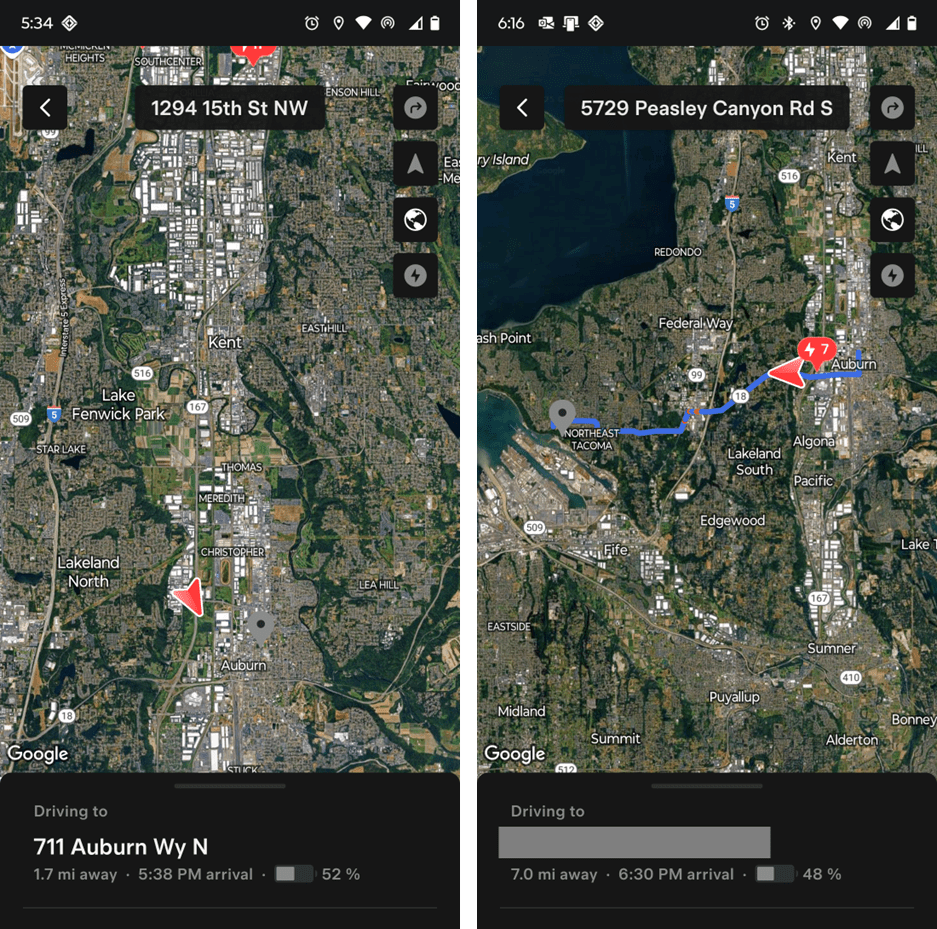
Now this isn’t really all that surprising — of course Tesla didn’t know we’d sold the car; that’s not how it “works” in the industry. But it’s an interesting edge case, and one I thought about frequently over the course of the next week as Miss Scarlet made its way through the resale process. I didn’t snap pictures of the car sitting at the Bellevue service center, but once it moved down to Kent I thought it’d be fun to keep a record.

First stop, Manheim Seattle Auto Auction. The Manheim facility is pretty huge; the car started in the middle of a huge lot, then next to a little outbuilding. It then appeared to move into a garage — probably for detailing — before bouncing from spot to spot in the lot again.

After a few days I got a navigation alert and found the car driving on its merry way to Worldwide Auto Group in Auburn. Two days later another alert and it was en route to a private home in Tacoma. I’ve masked out the address on that one because I’m assuming it’s an actual person who bought the car.

FINALLY, after eight days, a notification popped up on Lara’s phone that Worldwide was asking to take “ownership” of the Tesla — we agreed and and off she went into the sunset, leaving the Ventura Powerwall as the only Tesla product in our world.

What to make of this? Certainly I wasn’t “intended” to retain control of the car after I no longer owned it — but did it really matter? I think so — during this period I could see exactly where the car was, lock and unlock it, remote start, summon it if I was anywhere near by, and quite a bit more. It seems like bad guys have managed some pretty nasty stuff given a lot less access.

It’s always the edges

As someone who built their career around the craft of software engineering, it’s tough to get old and watch crappy AI and copy/paste code take over more and more of the world. Don’t get me wrong, it’s happening because mostly it does the job, and usually cheaper. But that doesn’t mean I need to like it.

Still, at least for now, the game is still on. Designing for the unexpected and the edges and future still matters, and those aren’t, so far, things the machines do well. Sometimes it’s an issue of technology and errors and such; more often it’s about user interaction. Don’t write us off quite yet!

Nit-Picking my Tesla

Lara, Copper and I just finished another LA-Seattle run in our 2019 Tesla; just about 23 hours on the road including charging stops. I enjoy the drive — great scenery along most of the route, a good audiobook or two, a lot of snacks, and a quick overnight to explore a new town (OK, usually the same town — there are great donuts in Mount Shasta).

Plus, of course, Autopilot and Dog Mode and optimized routing through the remarkable Supercharger network. Five years in, this stuff just doesn’t get old.

But that doesn’t mean it’s perfect. So from a place of love, and on the slim chance that tweeting non-crazy stuff at Elon still works, a few things that need fixing. From a guy who has spent a lot of highway miles thinking about it.

1. Routing & Charging Stops

Our car gets about 300 miles on a full charge, and there are a ton of Superchargers up and down the West Coast. Getting stranded is just not a real concern, unless you’re dumb — the same kind of dumb that runs out of gas in a “normal” car anyways. Just like in my “normal” car, I don’t like to push my range too low when I’m on a trip. I’m sure that different folks will have different tolerances for this kind of thing.

Tesla has a truly impressive routing system that takes charging into account. For example, when I start in Bellevue and want to drive south to Mount Shasta, it figures out where I’ll need to charge and adds those stops along the way: Kelso, Harrisburg, and Medford. It estimates the remaining charge at each stop, and how long I’ll have to stay before setting off again. It’s smart about charging time too — efficiency slows way down as you approach a full charge, so it usually arranges things so you only need to get to around 80% or even less before continuing.

And because many factors can impact range, it constantly re-assesses these stops as you drive. If the margin to reach a charger gets too slim, it will automatically find a closer option and rejigger the rest of the trip to match. It’s really fun to experience it in action — the kind of innovation that cloud-connected software makes possible.

Anyways, this is all great — BUT. As you can see, Tesla considers it safe to arrive at a stop with 9% charge remaining. At 9% I have about 25 miles left, the gauges are red and the car is disabling AC to conserve power. Sure it’s “fine,” but my blood pressure doesn’t concur.

Ask: Let me set a minimum charge level. I’d love to use 18% as the floor (about 55 miles for my car). Without this setting, I often feel compelled to mess around manually with my route to stop earlier and/or charge longer. Is it a huge deal? No — but it’d be nice to just not think about it. Help me out here.

2. Speed Limit Mistakes

When driving on Autopilot, the car automatically reduces speed when the effective speed limit drops (only slower, never faster). This is a fine feature, and certainly handy when you’re coming into a metro area or whatever and the limit is bopping up and down frequently. The problem is that, especially in the last few FSD iterations, the system gets confused by signs that set alternative limits — e.g., for trucks towing trailers or with more than two axles.

I actually didn’t realize that the car still tried to read signs at all; I just assumed it was using some published data source and GPS. But this happened at least ten times on our last drive; the sudden slowdown to 55 when you’re happily zipping along with traffic at 75 is jarring and annoying. I don’t think it’s strictly “dangerous” since braking is sensitive to traffic to the rear, but it still sucks.

Ask: Do better tracking the current speed limit.

3. Bogarting the Passing Lane

I like to drive consistently about five to eight miles over the speed limit; pretty safe from tickets while still moving along at a reasonable clip. This means I stay mostly in the travel lane, occasionally pulling over to pass folks on the left. Since I’m only going a few clicks faster than the folks I’m passing, maneuvers happen pretty slowly — so I keep an eye out for folks pulling up behind me in the fast lane and stay out of their way as much as possible.

FSD doesn’t deal super-well with this. When it notices that I’m going faster than a car ahead of me — even though that car is quite far ahead and I won’t approach it for some time — it moves into the fast lane. While I don’t love this, it would be OK except that the system is NOT sensitive to folks approaching from behind. So left to its own devices, at my preferred speed I’d be that a**hat squatting in the passing lane blocking people trying to pass.

The system does know generally that riding the passing lane is a bad idea and will sometimes move to the right. But something about this particular scenario screws up that behavior. Ask: Improve awareness of cars approaching from the rear and get out of their way.

4. Semi-Automated Lane Changes

Because of the behavior in #3, I will often put the car into “Minimal Lane Changes” mode. This setting limits automatic lane changes to safety reasons (e.g., to make room during a merge), or to follow an active route (e.g., to take a highway exit). Honestly I don’t mind this at all — it’s a nice compromise between letting the car do the work and being an active driver. But there are a couple of annoying things that need work.

First, the setting doesn’t stick. I cannot for the life of me figure out why they did it this way, but “Minimal Lane Changes” stays active only for the duration of the current drive. They take pains to tell you this every time you turn it on, so it’s not just a bug. I either have to remember myself, or wait for the car to attempt a lane change, cancel it, and catch the popup on the main console before it disappears. This is the only setting on the car that works this way! Ask: Make the “Minimal Lane Changes” setting sticky.

The other challenge here is that, just in the past few software iterations and only sometimes, the car is super-slow to respond to lane change requests. The way this works is the driver uses the turn signal to “request” a lane change, and the car automatically moves over when the target lane is clear. Typically this maneuver is very responsive and happens right away. But every few times now, the car just sits there. The blinker is on, the FSD display shows a clear path to the target lane, but nothing happens for 15-30 seconds. Eventually the car moves over, but only after somebody is annoyed — either me trying to pass, or somebody else trying to pass me!

Ask: Figure out why the car is (sometimes) sluggish to move into a clear lane.

5. Mid Speed Follow Distance

A few software iterations ago, Tesla removed the ability to fine-tune follow distance by number of car lengths. Instead, it’s managed by the FSD “profile” (Chill, Average, or Assertive) without direct control. As with some of the other issues I’ve brought up, “generally” it’s fine, but the inability to change the distance manually is a problem at speeds around 25-40mph, especially on a congested highway. In this range, the gap is too large and invites people to constantly cut in front of the car. Honestly it must be what it feels like to drive a semi.

I suspect this is going to be a tough one to get right automatically, because closing up the distance too much — even though it’s what almost all drivers do — certainly increases the risk of a fender bender. And there a ton of folks out there happy to hold FSD to a much higher standard that our fellow humans. So, my ask: At least for now, give me back fine-grained control of follow distance.

6. “Miles Remaining” Calculation

Maybe this is my blood pressure talking again, but one of the most important stats on the display is “Miles Remaining.” It basically takes the place of the gas gauge, giving me a sense of which destinations are in range and which are not. But unlike gas cars which have relatively consistent MPG, electric miles are super-variable. Elevation, speed, temperature and a host of other factors impact this — coming down out of the Oregon passes even turns the dial significantly backwards, gaining about twenty miles thanks to regenerative braking!

The value reported is clearly based on the last X miles of driving, for some unpublished value of X. That is, it’s pretty accurate if you keep driving in the same conditions. Which is fair if you think about it; the car can’t read your mind to know where you’ll be driving next. Or can it?

From what I can figure out, it seems that the “% remaining at next charge” value we talked about in #1 does predict the future, based on the active route. Those California-Oregon passes are my best recent example. Leaving Corning (CA) the Tesla told me I’d have about 15% charge remaining at my next stop in Medford (OR). By the time I’d climbed to the top of the passes, that expectation was down to 10%, but my “Miles Remaining” value was far, far lower — nowhere near enough to make Medford. But as I said earlier, as we dropped down the other side, “Miles Remaining” actually climbed about 20 miles and we cruised into Medford with just about exactly 10% remaining.

Now I don’t know what the software is really doing here. But somehow, even at the top of the pass, the routing system “knew” that I would use far less energy getting from there to Medford than I had so far. Maybe it did this using data from previous trips (my own and others’), or maybe it actually considers elevation. But one way or the other, the routing system consistently estimates residual charge better than the real-time system does.

Ask: When there is an active route, sync these systems up to show the same information!


There are other issues here and there: the automatic wipers are sadly useless, and I wish I could convince the falcon doors that the posts in my California garage are NOT in their way. But I don’t want to get greedy, and I don’t want to give the impression that these are anything but nits. To be clear, I love my Tesla. I’m turned off by some of Elon’s personal behavior, but I also believe he’s a straight-up genius whose ventures are having a remarkably positive impact on the future of our species. It’s adorable when folks claim (with all the confidence of a college freshman) that “anyone” could have done what he’s done. Spare me, please.

Lastly — I think it’s useful to note that all of the problems I’ve brought up are software issues. I can’t stress enough how important this is — what Tesla is building (and maybe Rivian and a few others) is fundamentally different than what the traditional automakers are building. They’re not just swapping out a gas motor for electric; they’re inventing a whole new kind of vehicle. It’s a lot less of a hassle to deal with a “recall” when it means your car updates overnight in your garage. The car just gets better and better day by day. That’s amazing, and super-fun.

The Elon / Twitter Bummer

Let’s get this out of the way up front: if you’re here expecting more snarky piling on about how stupid Elon Musk is, you’re going to have to get your schadenfreude fix elsewhere. Frankly, I think he’s a genius. A singular individual of our time that most fairly should be compared with Thomas Edison. But the whole Twitter thing really bums me out, because it makes obvious just how easily an unchecked strength can become a stunning downfall. It’s worth a few words; hopefully ones that will add a little bit of thoughtfulness to a mostly empty public “conversation.” We will see.

First let’s review a couple of the things Elon Musk has contributed to the world.

SpaceX

I’ve long been a believer in space exploration, so it’ll be no surprise that I have followed SpaceX since its earliest days. Back in 2002, Musk made a trip to Russia to acquire rockets at a commercially-reasonable price. The Russians basically told him he was an idiot and that it couldn’t be done. ON THE PLANE HOME, he put together a spreadsheet that showed that he could. His own people though he was nuts at first, but he was right. He surrounded himself with experts ranging from amateur to professional. He seeded money to folks and watched what happened. And most importantly he read, and read, and read. To call out just a few specifics he has cited:

… and then he made it happen. Bigtime. SpaceX is still today*** the only American company that can launch people into space. He puts satellites up for about $1,200 per pound (the Shuttle was $30,000). He has used the capability to launch Starlink, bringing the Internet to people and places previously left behind. The scope of what he has done here is stunning. No gimmicky “tourism.” He has never flown himself. He is simply knocking down real problems, one after another, while most others just second-guess from the sidelines.

Think space doesn’t matter? You’re dead wrong, but OK. How about climate change?

Tesla

It seems I can’t go a day without hearing Fleetwood Mac shill Chevy “EVs for Everyone.” Just like every other car company, Chevy would love you for you to believe that this was all their idea, but in reality they (together with all the usual suspects) have been slow-boating electrics since the 1980s. Not so Elon, who first invested in Tesla in 2004, and launched the Roadster in 2009 as CEO — more than a decade ago. We got our Model X in 2018 and it is straight up the best car I’ve ever owned.

What made the difference with Tesla was not new science, but a willingness to buck conventional wisdom as to what was “production ready.” Rather than whine about a lack of charging infrastructure, they designed the Supercharger and deployed enough of them that I’ve comfortably road-tripped the entire west coast of the USA multiple times. For daily use we haven’t even installed a dedicated charger of our own — we do just fine with a standard wall outlet. Software completes the package: we can safely leave our dog in a climate-controlled car; get automatically-recorded video of accidents or attempted theft; watch Netflix in the ferry line; verify that the doors are locked from our phones; ask it to extract itself from a tight parking space. I’m not allowed to take my hands off the wheel quite yet, but the Tesla drives itself way more than I do — stops at lights, changes lanes, you name it.

And sure they’ve been expensive so far, but at a base price of $47k the Model 3 is within striking distance of “normal” cars. It’s not a stretch to say that the EV industry is at a tipping point today directly because of what Elon has accomplished with Tesla over the past thirteen years.

But wait, there’s more. Tesla has used learning from the cars to become an energy company. One of my son’s best friends is kept busy way more than full-time installing Tesla Solar Roofs across the western half of the country. The Powerwall uses software to optimize power management — even automatically “topping up” the charge when severe weather is in the forecast.

I could keep going like this for a long time. And it’s easy for folks to talk about how nobody should be a billionaire or whatever, but he earned his money creating and selling things people want. His start in business was a $28k loan from his dad — a nice advantage to be sure, but turning $28k into $200B (legally) is a pretty good record and doesn’t happen by accident.

So then WTF happened?

In almost every case, Elon’s success has come down to “just doing” things that conventional wisdom said couldn’t be done. But it’s not a Zuckerberg “move fast and break things” vibe. He really listens to the arguments and the experts and the ideas — he is smart enough to understand what he learns — and only then he makes his call. Educated, but not encumbered, by those that have come before him. It’s just damn impressive.

The thing is, though, a key reason he can ignore the preconceptions of others is that he doesn’t have a ton of empathy for them (clinically it seems). Honestly he said it best himself on SNL:

“To anyone who I’ve offended [with my Twitter posts], I just want to say I reinvented electric cars, and I’m sending people to Mars in a rocket ship. Did you think I was also going to be a chill, normal dude?”

It’s funny because it’s true. The same quality that helps him ignore naysayers also keeps him from understanding the positions of folks that attack him (rightly or wrongly). Especially in the anonymous public sphere. I mean, it’s hard for anybody to turn the other cheek online — throw in some mental instability and it’s just not a shocker when he reacts without thinking.

With Twitter, this all just spun wildly out of control. He’s mad that people are mean to him on Twitter, and because he’s the richest guy in the freaking world his answer is to just buy it and kick off the people he doesn’t like. Obviously he regretted this just days after he set it in motion. But he’d gone too far and was legally required to finish what he started. And the real kicker this time is that — in stark contrast to his other ventures — with Twitter he didn’t do his homework. So in practice he’s just another clueless a$$hat money exec who shows up assuming he knows better. But he doesn’t. And that is exactly what we are seeing play out as he flails and reacts, flails and reacts, flails and reacts.

It just makes me really very sad.

I’m not asking you to feel sorry for the richest man in the world. And I’m not making excuses for this complete sh**show; it could have serious negative implications for all of us. It’s just a bummer to watch it unfold. I hope that history is able to remember both sides of the Elon story, because we’ll all still be benefiting from what he’s built long after people forget what a tweet was.

*** Between the time I wrote the first draft of this piece and published it, NASA finally launched the behemoth that is Artemis on its first trip around the moon. They haven’t put humans in the capsule yet, but it does appear we’re going to have a second option. Awesome, but that program feels a bit like a relic from the 80s. I hope it goes ok!