I realized today that I’ve written 109 (well I guess 110 now) long-form posts on shutdownhook.com since February 2021, the month I quit my job at Adaptive Biotechnologies and updated my LinkedIn bio to “Retired?” (now it’s got an exclamation point). That’s about two a month; sometimes more, sometimes less. Not bad.
I do link my posts on social media, and I love it when one strikes a chord with folks. But mostly I write for myself — a deal I made with the lazy part of me that would be happy to sit on the porch with a Coke Zero and just watch the world slide by. “You can retire, as long as you keep building and learning and trying new stuff.” Writing down that “stuff” gives it shape, and helps me calibrate whether I’m spending my gift of time well (or, sometimes, not).
I do like the writing part, too. A different form of creation, transforming a jumble of experiences and ideas into an efficient, coherent progression of words that tell their story. Somewhere around one or two thousand words usually does the trick. My friend Claude put together this little timeline of my posts (click for an interactive version):
Pretty cool, but it also highlights a slight but steady decline in frequency, especially over the past two years. Some of that is just time spent on other projects that may land on the gallery or book journal or (gasp) offline altogether. But that’s not the whole story.
Quieting
On the positive side, I think it mirrors a general “quieting” of my life that I’m a big fan of. I talk a lot less than I used to (Lara who has to live with me all the time now may disagree) — to the point where if I spend much time actively engaging with people it leaves me physically hoarse and exhausted.
This is a little weird after a decades-long career in an industry known for being loud and interruptive and full of voices. I thrived in that setting, but I like the alternative a lot. My ex-colleagues may derive some measure of amusement from this.
It’s not about less intensity or enthusiasm or fun or depth; it’s just different. It sounds so woo-woo I’m embarrassed to write it down, but the conversations and debates I used to have with people, I find myself having with wood, physics, nature, computers, animals, beaches, books, plants… it’s kind of neat.
Garden Party
I’m also writing less about “the old days,” except when some specific lesson or event has bearing on something new. I’ve heard loud and clear that folks love to hear about old Microsoft and the dot com days, and I get that — there are some great stories.
But like Ricky Nelson, I’m just more interested in looking forward than looking back. That’s why I moved to the West Coast in the first place, and why I jumped from industry to industry, and why I retired to explore new corners of the world. “If memories were all I sang, I’d rather drive a truck.” Although to be fair, “driving a truck” actually sounds super-fun too. Next month I’ll be road-tripping a cargo van across the USA; not quite the same but maybe a taste.
Of course there’s comfort and satisfaction in looking back, and there’s nothing wrong with that. I love beers with old friends, swapping stories and carping about kids these days. But I’ve seen too many people become frozen in time — the “old days” morph from real history into idealized fantasies that don’t serve anybody. Especially at a time when super-freaking old folks are clinging with their fingers and toes to political power.
Toxic Commons
Which brings me to the last, and most negative, thing slowing me down — a deep and real disillusionment with the state of our country. I try hard to separate my daily explorations from the endless stream of crazy news, but it doesn’t always work. And it probably shouldn’t, because what’s going on now is fundamentally sad, unnecessary and destructive.
It’s not all about “politics,” although the politicians and influencers have certainly figured out how to capitalize. It’s about an ignorant, petty mob of children vandalizing civilization and progress — far, far closer to the Red Guards than anything remotely American.
Actually, I keep finding myself using that term “American” as it has lived in my head since I was a kid. But I have to remind myself — WE voted for this, twice. WE are continuing to support it. WE love having our public health systems ruined by lying charlatans without medical experience. WE love having our capital city occupied by federal troops for no reason other than intimidation. WE love vilifying the poorest and most vulnerable to satisfy our pathetic, racist, everything-phobic egos. WE love that our president is a disgusting bloated coward, because it gives us an excuse for being awful ourselves.
The truth is, I don’t really know how to live in public anymore — so I do less of it. I’m still in the fight where I can have some impact, but it gets harder with every company and college and ex-colleague that bends their knee.
Whew. Sorry for the navel-gazing. But hey, it’s my site and I get to be a downer at least once every 110 posts. Next one will have some witty observations about AI or my latest power tool or how kids don’t know how to code anymore — I promise!
There’s a rule of multithreaded programming that says that if something can happen, it will. Package delivered at the same time the kitchen catches on fire and ALF is on live TV? For sure. I’ve been in countless debugging sessions where things that “can’t” happen absolutely, 100% happen.
Users are clever
Users are the same way. They may not all be tech savvy, but they’re incredibly creative. As with most things in my career, I first really learned this in the early 90s on the Microsoft Works team.
Works included simple desktop publishing features for making newsletters, invitations, posters, that kind of thing. Our customer service team sent us a case they were stuck on — the app would no longer let a user add content to their newsletter. It was a simple one-page document: header, footer, a few columns of content, maybe an image or two. That’s it. They tried saving a copy and using the new file, but no luck. They really didn’t want to start from scratch (I think they’d inherited the document from their predecessor).
The aha moment finally came when the rep asked the user to describe every action they were taking. Take last month’s article content, drag it off the page, add a new …. wait, what?
It turns out that this user didn’t know how to “delete” content blocks. But they realized that objects outside of the page boundaries on screen didn’t print — so each month they would just drag the old content blocks off the page and add new ones. Genius!
Except of course, the file got bigger and bigger and slower and slower until it just broke. I don’t remember if it was a memory problem, or if there were limits on the number of objects in a file, or what — but either way, a little education on “delete” and the newsletter was back in business.
We never expected users to be confused about deleting things. We never expected them to consider the off-the-page area as part of the real working space. More subtly, we’d never thought much at all about “periodicals” that used the same template time after time. And all of that’s on us — the user just found a creative way to do what they needed to do.
Whose car is it anyway?
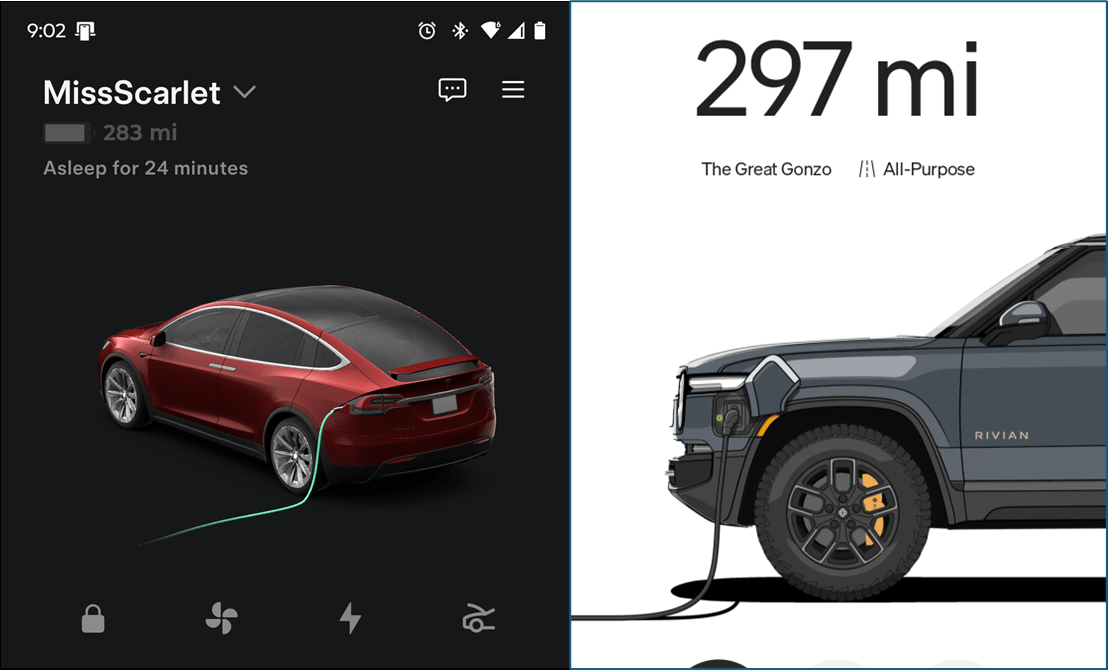
A couple of weeks ago we traded in our Tesla Model X for a Rivian R1S. If you know me you know how conflicted and sad I am about Elon (see here, here and here), but that’s a story for another day. We’ll take the Rivian on its first Cali road trip soon, and I’ll write up a comparison then. Stay tuned.
Before we traded in the Tesla, I logged us out of all the various accounts that we’d set up on the vehicle. At the Rivian service center we signed over the title, handed them the key fobs, and waved goodbye to “Miss Scarlet” as we drove our new car home. Done and dusted!
Later that day I got a phone notification that the Tesla doors were unlocked. When I opened the app it turned out that I was still fully in control of the car. Huh. I honked the horn a few times for fun and then moved on with my afternoon.
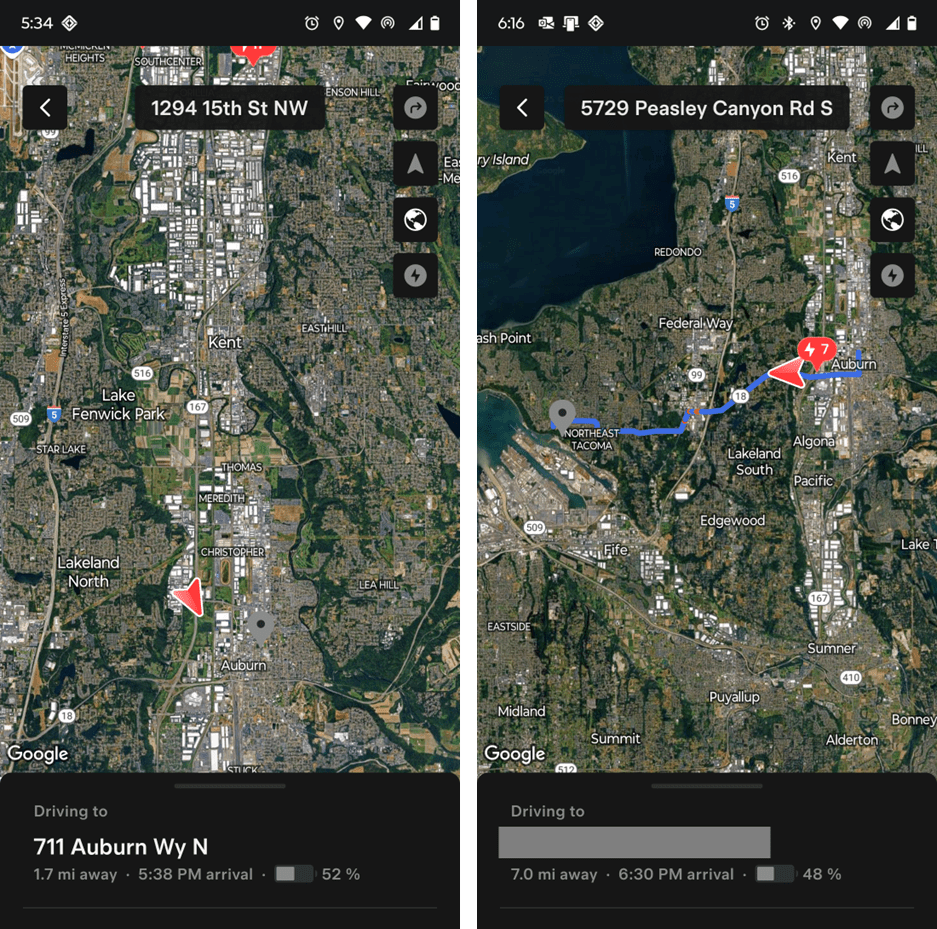
Now this isn’t really all that surprising — of course Tesla didn’t know we’d sold the car; that’s not how it “works” in the industry. But it’s an interesting edge case, and one I thought about frequently over the course of the next week as Miss Scarlet made its way through the resale process. I didn’t snap pictures of the car sitting at the Bellevue service center, but once it moved down to Kent I thought it’d be fun to keep a record.
First stop, Manheim Seattle Auto Auction. The Manheim facility is pretty huge; the car started in the middle of a huge lot, then next to a little outbuilding. It then appeared to move into a garage — probably for detailing — before bouncing from spot to spot in the lot again.
After a few days I got a navigation alert and found the car driving on its merry way to Worldwide Auto Group in Auburn. Two days later another alert and it was en route to a private home in Tacoma. I’ve masked out the address on that one because I’m assuming it’s an actual person who bought the car.
FINALLY, after eight days, a notification popped up on Lara’s phone that Worldwide was asking to take “ownership” of the Tesla — we agreed and and off she went into the sunset, leaving the Ventura Powerwall as the only Tesla product in our world.
What to make of this? Certainly I wasn’t “intended” to retain control of the car after I no longer owned it — but did it really matter? I think so — during this period I could see exactly where the car was, lock and unlock it, remote start, summon it if I was anywhere near by, and quite a bit more. It seems like bad guys have managed some pretty nasty stuff given a lot less access.
It’s always the edges
As someone who built their career around the craft of software engineering, it’s tough to get old and watch crappy AI and copy/paste code take over more and more of the world. Don’t get me wrong, it’s happening because mostly it does the job, and usually cheaper. But that doesn’t mean I need to like it.
Still, at least for now, the game is still on. Designing for the unexpected and the edges and future still matters, and those aren’t, so far, things the machines do well. Sometimes it’s an issue of technology and errors and such; more often it’s about user interaction. Don’t write us off quite yet!
Back in the nineties, recruiting was part of my job as a developer at Microsoft. The bar was high on purpose, and we were proud of it. A tough interview process is good for a lot of (mostly obvious) reasons, but for me the most important was that it created an assumption of competence at the company. If you were in the building, you probably weren’t an idiot.
As a person who collaborates best through, let’s say, “vigorous debate,” this was unbelievably liberating. If an idea was stupid, I could say that — and folks could say the same to me — and except in some very rare cases it didn’t get personal.
People are always surprised when I tell the (admittedly hilarious) story of Bill and the Gunshot Wound, but that was the path to success at Microsoft. Take a position and defend the hell out of it — if you win against all comers, you were probably right. I loved it, and it mostly worked.
And it’s exactly because it worked so well that it took me years to recognize that we (I) could do even better. Microsoft in the 80s and 90s conflated a particular personality type with intelligence and success. It just so happened to be my personality type, and I spent those early years blissfully working with a bunch of copies of myself. Building tools that worked the best for people like me.
Huh.
Now before we go too far here, let me be clear: I don’t abide stupid. Stupid kills and stupid loses. But it turns out that being stupid is mostly a personal choice. A half century of watching people has taught me that “everybody is good at something” is actually true — success comes down to taking ownership for figuring out what that is and working to become great at it. Stupid is just lazy.
Anyways, sitting here I can play back in my head dozens of real, brilliant individuals whose diversity and alternate perspectives made me and my products better — and sadly, a few (especially in my early years) that crashed out because I was unwilling to adjust my own behavior to optimize theirs.
I like to believe that I’ve gotten better at this year over year — but there is one person who probably doesn’t have a clue just how much she changed my life. She is extraordinarily smart, with a remarkable sense of personal responsibility and empathy. We built great things together for years, standing at whiteboards while I pushed and yelled and played every side of an argument to force her to defend her proposals.
Except one afternoon in the middle of a session, just a regular day, she sat down with actual tears in her eyes and asked me: “Why do you DO this?” She was exhausted and it was clear she had lost confidence in herself. I was honestly taken aback — none of this is personal, and if I didn’t believe she were the best person for this job, we wouldn’t have been there in the first place!
And yes, she “knew” this, but it didn’t matter. It turns out she was doing great work in spite of, not because of, my constant barrage of devil’s advocacy. Or more accurately, the way I was presenting my arguments. Some very small adjustments on my part led directly not just to a happier and more confident colleague, but to faster and better results. ***
And that’s the kicker — adjusting my own behavior and perceptions didn’t just help the other person, it got me more of what I wanted too, without costing me anything. You’d have to be crazy not to make that trade, right? Yet that is exactly what the “anti-woke” crowd pushes every day. Somehow we’ve created a ton of people that are so weak, so scared of anything that challenges themselves or their beliefs, they are actually pushing for the government to protect their fragile egos at their own expense. It’s insane.
The ”alpha male” narrative is not just super-weird, it’s also 100% upside down. What could possibly be weaker than crying “unfair” every time somebody challenges your position? Having a healthy ego by definition should mean you can listen and do a bit of introspection without being butt-hurt. I can be proud of my accomplishments and have a clear-eyed view of my unearned advantages at the same time.
This is true even if, in some incredibly rarified cases, the scales tip a little the other way. If DEI programs make it just a tiny bit harder for a white dude to get into a particular college or job, step up and work a little harder — isn’t that exactly what you’ve been saying to disadvantaged populations for years when the tilt is reversed? Don’t be such a chicken-sh*t.
I’m just really tired of the voice of “personal responsibility” and “strong men” being such a farce. Let’s create a world that works every day to be better and stronger and solve problems — not one that whines and cries and pretends it’s tough by buying a gun and hanging a flag on the truck. Wake up, white guys.
*** I suspect if my spouse reads this she’s going to laugh long and loud, because she taught me this lesson very early in our relationship — yelling in an argument was NOT going to end well. So why did it take so long to translate to work? Human psychology is weird, man.
Just a few months after the Great Gunshot Search incident of 2005, I found myself at Washington Hospital Center while Dr. Craig Feied showed us list after list on a huge (for the time) monitor. Real-time patient rosters for the ER and ICU, sure, but that was just the warmup. Rooms that needed cleaning. Patients who needed ventilation tubes replaced. Insurance companies with elevated rates of rejected claims. Patients eligible for actively-recruiting complex trials. He just kept going, like a fireworks show where every time you think you just saw the finale they start up again. Incredible stuff. Anyways, cut to a few months later and we (Microsoft) announced the acquisition of Azyxxi — adding an enterprise solution to our growing portfolio in Health Solutions.
Sadly — and despite a ton of work — we were never really able to scale that incredible solution at WHC into a product that realized the same value at other institutions. That’s not to say there weren’t some great successes, because there absolutely were. But at the end of the day, there was just something about Azyxxi that we couldn’t put into a box. And while it’s tempting to just say that it was a timing problem, I don’t think that was it. Even today I don’t see anything that delivers the magic we saw in Dr. Craig’s office — just flashy “innovation” videos and presentations that never quite make it to the floor in real life.
So what was the problem? Anything we can do about it? I dunno — let’s talk it out.
Oh, and just to get it out of the way early, “Azyxxi” doesn’t mean anything — it’s just a made-up word engineered to be really easy to find with Google. We renamed it “Amalga” at Microsoft, which does actually have some meaning behind it but in retrospect sounds a bit like some kind of scary semi-sentient goo. Moving on.
Just what was it?
A correct but only semi-helpful description of Azyxxi is that it was a data analysis and application platform for healthcare. Three parts to that: (a) data analysis, like a big data warehouse; (b) an application platform so insights gained from analysis could be put into on-the-floor solutions; (c) made for healthcare, which means there was functionality built-in that targeted weirdnesses endemic to the business of providing care. This is of course a mouthful, and one of the reasons it was hard to pitch the product outside of specific use cases. A better and more concrete way of looking at the product is to break it down into five key activities:
1. Get the Data
Healthcare data is incredibly diverse and notoriously messy — images, free text notes, lab results, insurance documents, etc. etc.. The first rule of the Azyxxi Way (yes we actually referred to it like that) was to “get the data, all of it, without trying to clean it up.” Which is to say, it was a Data Lake before Data Lakes were cool (or even a term). In 2006 the conventional wisdom for data warehousing was “Extract, Transform, Load.” ETL pipelines extract data out of source systems, transform it into (usually) a “star schema” optimized for analysis, and load it into a target database. In this model an enormous amount of upfront thought goes into what data is important, and transforming/normalizing it into a shape that can efficiently answer a set of predefined questions.
Azyxxi’s insight was that ETL prework is always wrong, and leaves you with a brittle data warehouse unable to answer novel questions as they inevitably arise. Instead they talked about “ELT” — loading everything just as it was in the source systems and figuring out the “transform” part later. This seems obvious now, but we all used to worry a ton about performance. Azyxxi used SQL Server, and the founders were constantly pushing its boundaries, typically with great success. Sure, some queries were really slow — but you could at least ask the question!
2. Ask Novel Questions
Which leads us to the first user-driven Azyxxi experience — exploration. Using an Excel-like grid display, users had the ability to query source tables individually or via pre-configured “joins” that linked records. Sort, filter, etc. — all the standard stuff was there. Of course there was access control, but this was a care-focused tool in a care-delivery setting — by default users could see a LOT. And as noted above they could get themselves into “trouble” by running queries that took hours or days, but SQL Server is smart and it was mostly just fine.
The key is that there was a culture at the early Azyxxi sites, developed over many years, of asking questions and self-serving the answers. This is not typical! Most nurses and doctors ask themselves data-driven questions in passing, but never follow them up. Working with the IT department to run a report, combine data from multiple sources, get approval to make a change — it just isn’t worth the hassle. So great ideas just die on the vine every day. Azyxxi users knew they had a way to answer their questions themselves — and so they did.
3. Bring Insights to the Floor
It’s awesome to be able to ask questions. But it’s only really impactful when you can use the answers to effect change in real life. With Azyxxi, one-off queries could be saved together with all of their settings — including automatic refresh and kiosk-style display — and shared with other users or departments.
If you’ve been a hospital inpatient or visitor lately, almost certainly you’ve seen the patient roster grid at the central nurse’s station. At my recent colectomy the surgical unit had a live status board that helped my wife keep track of my progress through the building. Great stuff, but every one of these dashboards is an IT project, and no IT project is trivial. With Azyxxi, more than a decade ago, users could create and deploy them by themselves.
But hold on. I’ve already said twice that novel queries against source data could be really slow — a “real-time” dashboard that takes an hour to load isn’t going to get very far, and end users don’t have the skills or tools to fix it. What to do?
Azyxxi empowered the IT folks to run behind user innovation and keep things humming. Each user-created list was driven by an automatically generated SQL query — and anyone who has written interfaces like this know that they can become very inefficient very quickly. Slow queries were addressed using a sliding scale of intervention:
Hand-code the query. SQL experts on the Azyxxi team were great at re-writing queries for performance. The new query could be inserted behind the user grid transparently and without downtime — it just looked like magic to the end users.
Pre-calculate joins or derived data. When hand-coding queries wasn’t enough, the team could hook into the “EL” part of data acquisition and start doing a little “T” with code. For example, data from real-time monitors might be aggregated into hourly statistics. Or logic to group disease codes into higher-level buckets could be applied ahead of time. These were the same kind of “transforms” done in every data warehouse — but only done after a particular use case proved necessary and helpful.
Fully-materialize user grids. An extreme version of pre-calculation, sometimes code would be written to build an entire user grid as its own table. Querying these tables was lightning fast, but creating them of course took the most IT effort.
The refrain here was just-in-time optimization. The software made it easy for the Azyxxi IT team to see which queries were active, and to assess which approach would lead to acceptable performance. That is, they optimized scarce IT expertise to only do work that was already known to have real clinical value. Compare this to the torturous processes of up-front prioritization and resource allocation in most of the world.
Axyxxi also made these transforms sustainable by strictly enforcing one-way data dependency. Only one “parser” (not really a parser in the CS sense, just Azyxxi terminology for ELT code) could write to one target (typically a table or set of tables), and then optionally trigger additional downstream parsers to perform further transformation into other targets. This “forward-only-write” approach provided a ton of benefit — most importantly automatic error and disaster recovery. At any time, parsers at any level of the hierarchy could be re-run from scratch, trigger their downstream dependencies, and end up with an exact copy of what existed before the recovery event.
Even these dependencies could become complicated, and nobody loved the idea of a “full re-parse” — but it was an invaluable backup plan. One we took advantage of more often than you’d expect!
4. Close the Loop
Because data acquisition was near-real-time, most grids didn’t require additional user input to be useful. New lab results arriving for a patient naturally caused them to fall off of the “patients awaiting lab results” grid. It’s kind of amazing how many problems fit this simple pattern — auto-refreshing grids on a kiosk screen prove to be transformative.
But sometimes there was no “source system” to provide updates — e.g., a list that alerted facilities to newly-vacated rooms that needed to be cleaned. The “newly-vacated” part came from the external EHR system, but cleaning times did not. Azyxxi included user-editable fields and forms for this purpose — never changing ingested data, just adding new data to the system. A facilities employee could simply click a row after taking care of a room, and the grid updated automatically.
Users could create pretty complex forms and such in the system — but honestly they rarely did. Usually it was simply checking an item off of a list, maybe with a bit of extra context about the activity. Simple stuff that created beautifully elegant solutions for a ton of different situations.
5. Improve the data
There are a bunch of challenges specific to healthcare data. Take for example the humble patient identifier — by law we have no federal patient identification number in the United States. The amount of time and money spent making sure records are assigned to the right human is absolutely shocking, but there it is. Especially in high-stress hospital admission settings, recorded demographics are often wrong or missing — every significant health care information system has to deal with this.
Privacy rules are another one. Providers in a care setting have very few restrictions on the data they can see, but the same isn’t true for all employees, and certainly not for visitors walking by kiosk displays in a hallway. There are specific rules around how data needs to be anonymized and what data elements can appear together — more work for users trying to build usable queries.
Even simply figuring out why a patient is in the hospital can be tough. Different systems use different “coding systems”, or sometimes no coding at all. A huge federal project called the “Unified Medical Language System” is an attempt to help navigate all of this, but it’s pretty hairy stuff and not in any way “user ready.”
Azyxxi’s “one way” parsing system made it relatively easy to help create “augmented” tables to handle these things once rather than many times. My favorite example of this was the “PHI filter” parser, which would take a table and automatically create a version that masked or otherwise anonymized relevant fields. The user interface could then be directed at the original or “safe” version of the table, depending on the rights of the logged-on user.
This all sounds great, so what happened?
If you’ve read along this far, you probably already have a sense of the challenges we were about to face as Azyxxi v1 became Amalga v2. We spent a lot of time upgrading and hardening the software, modernizing UX, etc. – and that all went fine, albeit with some inevitable cultural churn. And despite a non-trivial problem with “channel conflict” — our nascent sales team was getting a positive response to the story we were telling. I mean, a simple slide show of awesome use cases at WHC and other Azyxxi sites was pretty compelling.
Side note: channel conflict is a tough thing at Microsoft! The sales team is used to co-selling with third parties that build solutions on top of Microsoft platforms like Windows and SQL Server (and now Azure). So they were best buddies with a whole bunch of healthcare data analytics companies that were in direct competition with Amalga … oops! This problem is a hassle for every vertical solution at Microsoft, and they’ve never really figured out how to deal with it. I don’t think it played a primary role in Amalga’s market woes, but it sure didn’t help.
So the software was OK — but right away, early implementations just weren’t making it into production use on schedule. What the heck?
Oops, IT Culture
First, it turned out that we had a significant problem fighting IT culture at our target customers. The Azyxxi team at WHC and its sister organizations were also the Azyxxi developers. For them, the counter-conventional-wisdom practices of Azyxxi were the whole point, and they knew how to turn every knob and dial to achieve just-in-time optimization. But your typical health system IT department — even those run by really competent folks — just doesn’t think that way. They are a cost center with an endless list of projects and requests, often driven more by risk avoidance than innovation. Most of these shops also already had some sort of data analytics solution; while they invariably sucked, they existed and were a sunk cost that the team knew how to use.
The Amalga team walked in and just started breaking eggs left and right. We asked for a very large up-front investment, using weird new techniques — all for a few smallish initial use cases that had captured the eye of some annoying but influential doctor or the Chief Medical Officer. We told them to “just get the data, don’t worry about what you think you need.” We told them that SQL Server was fine for things that made their SQL experts faint on the spot. We told them to give broad access to users rather than assigning rights on a “need to know” basis.
In short, we told them to do everything differently, using coding skills they didn’t even have. Not surprisingly, that didn’t work out. In almost every case we became bogged down by “prioritization” and “project planning” that stopped implementations cold. And even when we finally were able to eke out an MVP implementation, we almost always ran straight into our second stumbling block.
Oops, User Culture
The Amalga team used to talk a lot about “democratizing” access to data. And to be sure, nobody has better insight into day-to-day problems than nurses and docs and the others doing the actual work of providing care. But as it turns out, not a lot of these folks have the skills, motivation or time to dig in and create the kind of self-reinforcing flywheel of improvements that Amalga was designed for.
At least, that’s the way it is in most healthcare systems. The IT department and leadership push technology down onto the working staff, and they just have to deal with it. Sometimes it’s great, sometimes it’s awful, but either way it typically isn’t something they are rewarded for getting involved with. Executives and maybe department heads ask the IT department to prepare “reports” that typically show very high-level, lagging indicators of quality or financial performance. But technology-driven workflow changes? It’s usually a pretty small bunch making those calls.
This was a challenge at the early Azyxxi sites, too. But a combination of (a) sustained evangelist outreach from the Azyxxi team itself, and (b) successful users becoming evangelists themselves, created the right environment to bring more and more users into the game. Almost every department had at least one active Azyxxi user who would work with their colleagues to leverage the tools. But at new Amalga sites, where the IT team was often reluctant to begin with, with no established pattern of users self-serving their own solutions, and only a few small uses cases deployed — starting the flywheel was a tall order indeed.
It’s tough to establish a system when you’re fighting culture wars on both the supply and demand fronts!
The good fight: Amalga v3
With a pretty clear set of problems in front of us, the Amalga team set out strategies to fix them. I’m really proud of this time in HSG — the team came together in one of those moments of shared purpose that is both rare and exhilarating. Some of the software we built would be state of the art even today. Bryan, Mehul, Kishore, Noel, Adeel, Sohail, Sumeet, Mahmood, Puneet, Vikas, Imran, Matt, Linda, Shawna, Manish, Gopal, Pierre, Jay, Bei-Jing, many many more … it was just a ton of fun.
Goal #1: Easier for IT
The biggest knock on Amalga v2 from IT was that it was just too slow. Of course, having been on this journey with me you know that this misses the point. Amalga was designed for just-in-time optimization — if important queries were “slow” they just needed to be optimized by hand-coding, pre-computing key values, or fully materializing tables. Simple! Unless of course your IT team doesn’t have advanced coding or SQL skills. Which was, unfortunately, most customers.
We took on a bunch of features to better automate JIT optimization, but the biggest by far was automatic materialization. Based on a list query created either in the Amalga user interface or by hand, Amalga v3 could automatically create and maintain a flat, simple table representing the results, with maximally-efficient inserts and updates at parse time. This meant that every grid could be made performant simply by checking a box to turn on materialization. OK, maybe not that easy — but pretty close.
We also made initial data acquisition simpler by introducing a “super parser” that could be driven by configuration rather than by code. We put together a sophisticated install and patch system that enabled upgrades without disturbing user customizations. We extended our custom client with Sharepoint integration, making it easier to combine Amalga and other corporate content, and reduced the burden of user and group management. And much more.
Goal #2: Shorter Time-to-Value for Users
If users weren’t creating their own apps, we’d bring the apps to them!
On top of the new Sharepoint integration, we created a configuration framework for describing data requirements for detailed, targeted use cases. Deploying an app was simply a matter of identifying the source for each data element required — a “checklist” kind of task that was easy to explain and easy to do. And while installing the first app or two would certainly require new parsing and data extraction work, at critical mass users were mostly reusing existing data elements, making it far easier to demonstrate the value of building a “data asset” over time.
And then we went mining for apps. We dug up every Azyxxi use case and convinced early Amalga customers to share theirs. Even better, we created a developer program, both for consultants who helped customers build their own apps (e.g., Avenade) and third party developers that created their own (e.g., CitiusTech). Classic Microsoft playbook — and a great way to recapture Dr. Craig’s fireworks-that-never-end sales experience.
Goal #3: Kickstart Evangelism
Lastly, we dropped our own people into customer sites, to be the early evangelists they needed. I was the executive sponsor for Seattle Children’s Hospital and was there at least once a week in person to help the IT team solve problems, meet with docs and nurses to develop lists and apps, take feedback and get yelled at, whatever it took. I learned a ton, and was able to bring that learning back to the team. I’ll always appreciate the time I spent there with Drex and Ted — even if it wasn’t always fun.
Honestly, I’ve never seen another organization commit to its customers so hard. Every single person on the team was assigned to at least one site — execs, sales, engineers, everyone. And our customers’ success was part of our annual review. If we just couldn’t get somebody over the hump, it sure wasn’t for a lack of sweat equity. In fact I forgot about this, but you can still find demos made by yours truly more than a decade ago! Here’s one inspired by Atul Gawande’s Checklist Manifesto:
And then came Caradigm (and Satya)
Update: Originally I dated the below as 2014 and Renato corrected me — the Caradigm JV was formed in 2012, two years before Satya’s official start date and my ultimate departure from the company. Those two years were very quite chaotic between the two CEOs and I’m afraid my brain conflated some things — thanks for setting me straight!
By 2012 we’d been in a long, pitched battle — making progress, but still tough. Then again, that had pretty much been the plan we set with Steve back in 2006; it was going to take a long time for Microsoft to really get established in a vertical industry like healthcare. I have always admired Steve for his willingness to commit and stick with a plan — people love to winge, but he was great for Microsoft for a long time.
But companies are not families, and shareholders and the market were clearly ready for new strategies and new blood as CEO. And where Steve’s approach was to go broad, Satya’s was (is) to go deep on just a few things — and clearly he was on the rise. Don’t get me wrong, it has clearly been a winning strategy for Azure and the business; a big part of my portfolio is still in Microsoft and my retirement is thankful for his approach! But it did shine a very, very bright spotlight on ventures like Health Solutions that weren’t core to the platform business and weren’t making any real money (yet). Totally fair.
So we had to find another path for Amalga.
During the last few years, it had become clear that a key use case for Amalga was population management — the idea that with a more comprehensive, long-term view of an individual we could help them stay healthy rather than just treat them when they’re sick. This is the driving force behind “value-based” care initiatives like Medicare Advantage, and why you see these plans promoting healthy lifestyle options like weight loss and smoking cessation — small early investments that can make a big difference in costs (and health) later in life.
But to do this well you need to know more about an individual than just when they show up at the hospital. It turns out that Amalga was very well-suited to this task — able to pull in data from all kinds of diverse sources and, well, amalgamate it into a comprehensive view (I had to do that at least once, right?). In fact, Amalga apps related to population health were typically our most successful.
It turned out that GE HealthCare was also interested in this space, building on their existing hardware and consulting businesses. Thus was born Caradigm, a joint venture that set out with partners like Geisinger Health to build population health management tools on top of Amalga. The new company took some employees from Microsoft but was more new than old, and fought the good fight for a few years until they were ultimately bought by Imprivata and frankly I’ve lost the thread from there.
TLDR; What to make of it all?
In retrospect, I think it’s pretty clear that Amalga’s problems were really just Healthcare’s problems. Not technology — Amalga v3 was certainly more sophisticated than Azyxxi v1, but both of them could do the job. Data and workflows in healthcare are just so fragmented and so diverse that a successful data-driven enterprise requires the problem-solving skills of people at least as much as technology. More specifically, two types of people:
Developers that can quickly build and maintain site-specific code.
Evangelists that can bring potential to life for “regular” users.
Of course a certain level of technology is required just to house and present the data. And great tech can be an enabler and an accelerant. But without real people in the mix it’s hard for me to imagine a breakout product that changes the game on its own. Bummah.
But let me end with two “maybes” that just might provide some hope for the future:
MAYBE all of the layoffs in pure tech will change the game a bit. As somebody who has built teams in both “tech-first” and “industry-first” companies, I know how tough it is to attract really top talent into industry. Tech has always paid more and had way more nerd cred. I find that annoying because it can be incredibly rewarding to do something real and concrete — as much as I loved Microsoft, nothing I ever did there matched the impact of collaboration with clinicians and patients at Adaptive Biotechnologies. If we can get more talent into these companies, maybe it’ll pay off with a few more Azyxxi-like solutions.
Or MAYBE ChatGPT-like models will be able to start filling in those gaps — they can already write code pretty well, and I wouldn’t be shocked to see a model create high-impact dashboards using historical performance data as a prompt. This one may be a little more out there, but if AI could create an 80% solution, that might just be enough to get users excited about the possibilities.
Who knows? I just hope folks find some interesting nuggets in this very long post — and if nothing else I had a great time walking myself down memory lane. I will leave you with this video, made after the acquisition but sadly before I was spending day-to-day time on the product. We do get knocked down, and 100% we get up again!
I tend to be a mostly forward-looking person, but there’s nothing like a bit of nostalgia once in awhile.
After finally putting together a pretty solid cold storage solution for the family, I spent a little time going through my own document folders to see if there was anything there I really didn’t want to lose. The structure there is an amusing recursive walk through the last fifteen years of my career — each time I get a new laptop I just copy over my old Documents folder, so it looks like this:
seanno99 – Documents
some files
seanno98 – Documents
some files
seanno97 – Documents
some files
seanno96 – Documents
etc.
Yeah of course there are way better ways to manage this. But the complete lack of useful organization does set the stage for some amusing archeological discoveries. Case in point, last night I stumbled across a bunch of screen mocks for the service that ultimately became the embedded “Health Answer” in Bing Search (this was a long time ago, I don’t know if they still call them “Answers” or not, and I’m quite sure the original code is long gone).
One image in particular brought me right back to a snowy day in Redmond, Washington — one of my favorite memories in a luck-filled career full of great ones, probably about nine months before the mock was created.
Back then, the major engines didn’t really consider “health” to be anything special. This was true of most specialized domains — innovations around generalized search were coming so hot and heavy that any kind of curation or specialized algorithms just seemed like a waste of time. My long-time partner Peter Neupert and I believed that this was a mistake, and that “health” represented a huge opportunity for Microsoft both in search and elsewhere. There was a bunch of evidence for this that isn’t worth spending time on here — the important part is that we were confident enough to pitch Microsoft on creating a big-time, long-term investment in the space. I’m forever thankful that I was introduced to Peter way back in 1998; he has a scope of vision that I’ve been drafting off for a quarter century now.
Anyways, back in the late Fall of 2005 we were set to pitch this investment to Steve and Bill. The day arrives and it turns out that the Northwest has just been hit by a snowstorm — I can’t find a reference to the storm anywhere online, so it was probably something lame like six inches, but that’s more than enough to knock out the entire Seattle area. There is no power on the Microsoft campus and most folks are hiding in their homes with a stock of fresh water and canned soup. But Steve and Bill apparently have a generator in their little office kingdom, so we’re on. Somebody ran an extension cord into the conference room and set up a few lights, but there’s this great shadowy end-of-the-world vibe in the room — sweet. So we launch into our song and dance, a key part of which is the importance of health-specific search.
And here comes Bill. Now, he has gotten a lot of sh*t in the press lately, and I have no reason to question the legitimacy of the claims being made. This bums me out, because Bill Gates is one of the very few people in the world that I have been truly impressed by. He is scary, scary smart — driven by numbers and logic, and just as ready to hear that he’s an idiot as he is to tell you that you are. For my purposes here, I choose to remember this Bill, the one I’ve gotten to interact with.
“This is the stupidest idea I have ever heard.”
Bill dismisses the entire idea that people would search for issues related to their health. He expresses this with a small one-act play: “Oh, oh, I’ve been shot!” — he clutches his chest and starts dragging himself towards the table — “I don’t know what to do, let me open up my computer” — he stumbles and hauls himself up to the laptop — “No need for the ER, I’ll just search for ‘gunshot wound’” — sadly he collapses before he can get his search results. And, scene.
Suffice to say that backing down is not the right way to win a debate with Bill. I remember saying something that involved the words “ridiculous” and “bullsh*t” but that’s it — I was in The Zone. Fast forward about a week, the snow melted and Peter did some background magic and our funding was in the bag.
A few months later, we ended up buying a neat little company called Medstory that had created an engine dedicated to health search. And thus were born the “HealthVault Search” mocks that I found deep in the depths of my archives the other day. The best part? If you’ve looked at the image, you already know the punch line: GUNSHOT WOUND was immortalized as the go-to search phrase for the first image presented — every meeting, every time.